


Most marketing teams don’t have a traffic problem; they have a data problem. By the time Q2 rolls around, dashboards are bloated, reports contradict each other, and “performance” depends on which chart you’re looking at. The result? Decisions take longer to make, budgets end up misallocated, and teams start optimizing for the wrong things.
A data detox fixes that! It’s not about getting more numbers; it’s about getting cleaner, truer, decision-ready data so your strategy starts compounding instead of drifting.
If you’re running campaigns across platforms like Google, Meta, and Microsoft, this kind of analytics hygiene isn’t optional. It’s how you protect performance before scale.
Why “Dirty Data” is Quietly Killing Performance
Here’s what dirty analytics usually looks like:
- Duplicate conversions being counted
- Old goals nobody uses anymore
- Events firing inconsistently
- Channels mislabeled or lumped together
- Vanity metrics getting more attention than revenue
- Reports that look impressive but don’t answer real questions
None of this breaks your ads. It breaks your decisions. When your data is messy, you don’t know:
- What’s actually driving growth
- What’s wasting budget
- Which campaigns deserve more spend
- Where your real bottlenecks are
So you end up optimizing based on noise.
Start with Analytics Hygiene, Not New Tools
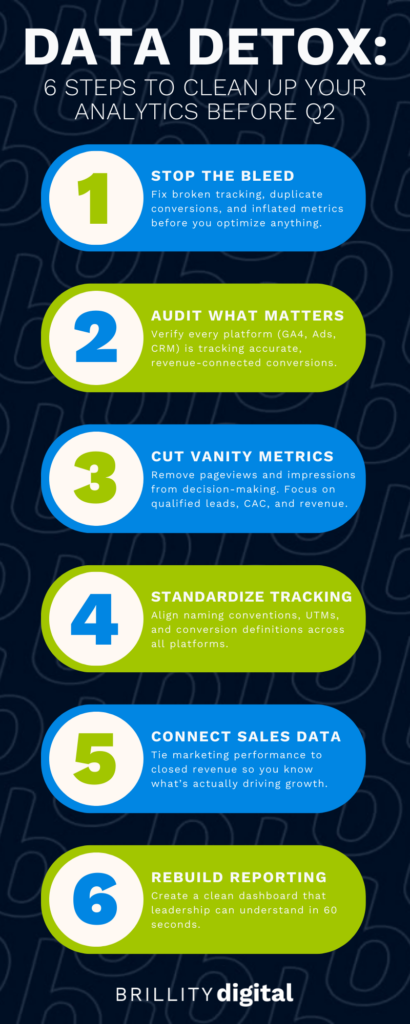
Before you add another dashboard or tracking layer, clean what you already have. A proper analytics hygiene pass includes:
- Removing duplicate or obsolete conversions
- Standardizing naming conversions across campaigns and events
- Verifying that key actions fire once and only once
- Checking that sources, mediums, and channels are classified correctly
- Making sure revenue, leads, and core actions are tracked consistently
Think of it like cleaning your kitchen before you cook. More tools won’t fix a dirty foundation.
Run a Metrics Audit
Most teams track too much and trust too little. A metrics audit asks three simple questions:
- Which numbers actually influence decisions?
- Which metrics are just “nice to look at”?
- Which metrics are actively misleading us?
High-impact metrics usually include:
- Cost per qualified lead or acquisition
- Conversion rate by channel and campaign
- Revenue or pipeline influenced
- Return on ad spend or ROI
- Lead quality or close rate
Low-impact metrics often include:
- Raw impressions
- Clicks without context
- Engagement without outcomes
- Averages that hide real variance
The goal isn’t fewer metrics; it’s fewer distractions.
Re-Align Tracking to How the Business Actually Works
One of the biggest analytics mistakes is tracking what’s easy instead of what matters. Your tracking should reflect:
- How a lead becomes a customer
- Which steps in the funnel matter most
- Where deals are won or lost
- What “quality” actually means for your business
That often means:
- Separating micro-conversions from true business conversions
- Weighting actions differently in reporting
- Distinguishing between leads and qualified leads
- Connecting marketing data to sales or revenue data where possible
If your reports don’t mirror real-world outcomes, they’re just dashboards, not decision systems.
Fix Your Reporting Before You Fix Your Campaigns
Here’s a hard truth: Most “underperforming” campaigns are judged by bad reporting. Clean reporting should:
- Show trends, not just snapshots
- Separate signal from noise
- Make trade-offs obvious
- Tie spend to outcomes
- Highlight what to do next, not just what happened
Good reports answer questions like:
- Where should we increase budget right now?
- What should we pause or fix?
- Which channel is driving quality, not just volume?
- What’s improving month-over-month, and why?
If your reporting can’t do that, no amount of optimization will stick.
Set a Q2 Baseline You Can Actually Trust
A data detox isn’t just clean up; it’s resetting your baseline. Before Q2 scaling starts, you want:
- Clean conversion tracking
- Clear definitions of success
- Agreed-upon core KPIs
- Reports everyone trusts
- A single source of truth for performance
That way, when you scale:
- You know what’s really working
- You catch problems earlier
- You can move budget with confidence
- You can defend decisions with real evidence
This is how performance marketing stops being reactive and starts being strategic.
The Strategic Edge Most Teams Miss
Clean data doesn’t just improve reporting. It improves every decision that follows. It makes:
- Budget allocation smarter
- Testing faster
- Scaling safer
- Forecasting more accurate
- Strategy discussions more productive
And it creates alignment between marketing, sales, and leadership, because everyone is finally looking at the same reality.
Where Brillity Fits In
At Brillity Digital, the focus isn’t just on running campaigns. It’s on building measurement systems you can actually trust. That means:
- Auditing analytics before scaling spend
- Cleaning up tracking and conversion logic
- Simplifying reporting to what drives decisions
- Turning data into direction, not just dashboards
Q2 is where momentum is built or lost. A clean data foundation is how you make sure it’s built on truth, not guesswork. Because better data doesn’t just make you look smarter. It makes your marketing work better.
If your reporting feels cluttered, inconsistent, or hard to trust, now is the time for a reset. A proper data detox before Q2 can uncover wasted spend, clarify what’s actually driving growth, and give you a foundation you can scale with confidence. If you want help auditing your analytics, cleaning up your tracking, and building reporting that supports real decisions, not just pretty dashboards, let’s start with a strategy-first review and get your data working for your business, not against it!


